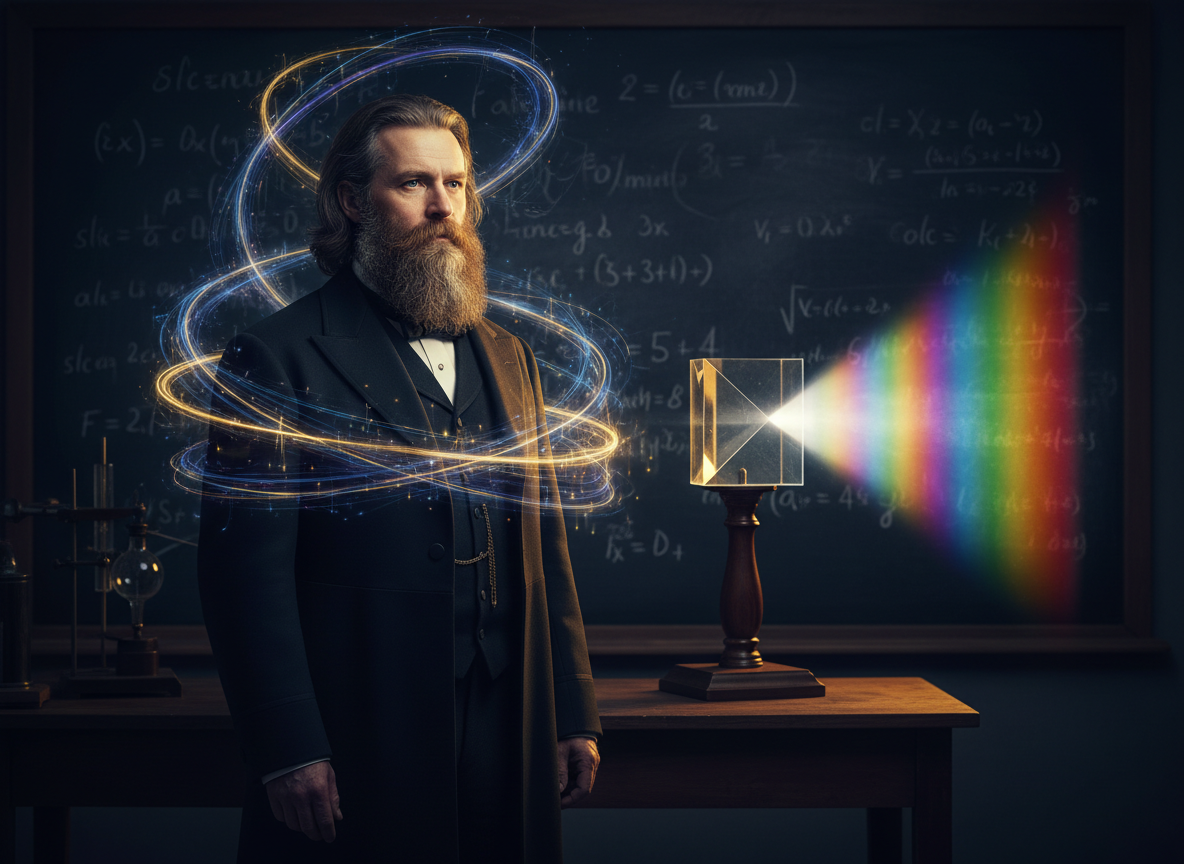
James Clerk Maxwell is one of the central figures in the history of physics. His work showed that electricity and magnetism were not separate phenomena but parts of a single electromagnetic framework — and that light itself is an electromagnetic wave.
Why Maxwell’s equations changed physics
Maxwell brought earlier experimental discoveries into a mathematical theory that described how electric and magnetic fields behave and interact. The result was a unification powerful enough to predict electromagnetic waves, connecting optics with electricity and magnetism.
More than electromagnetism
Maxwell also made important contributions to color vision, photography, statistical physics and the study of Saturn’s rings. His work on the kinetic theory of gases helped lead to the Maxwell–Boltzmann distribution, while his analysis of Saturn’s rings demonstrated that they could not behave as a single solid body.
Maxwell’s influence on modern science
Later physicists built on Maxwell’s framework to develop radio technology, relativity, quantum physics and much of modern electrical engineering. Albert Einstein’s work on relativity emerged in a scientific world already transformed by Maxwell’s equations.
Maxwell’s greatest achievement was not one isolated discovery. It was showing that apparently different forces could be understood as parts of one deeper system.
Read more from Muslance
- Where the Elements in Your Body Really Came From
- William Harvey and the Experiment That Changed How We Understand Blood
Watch more documentaries on Muslance on YouTube.
Leave a Reply