MUSLANCE / MATTER & CHEMISTRY
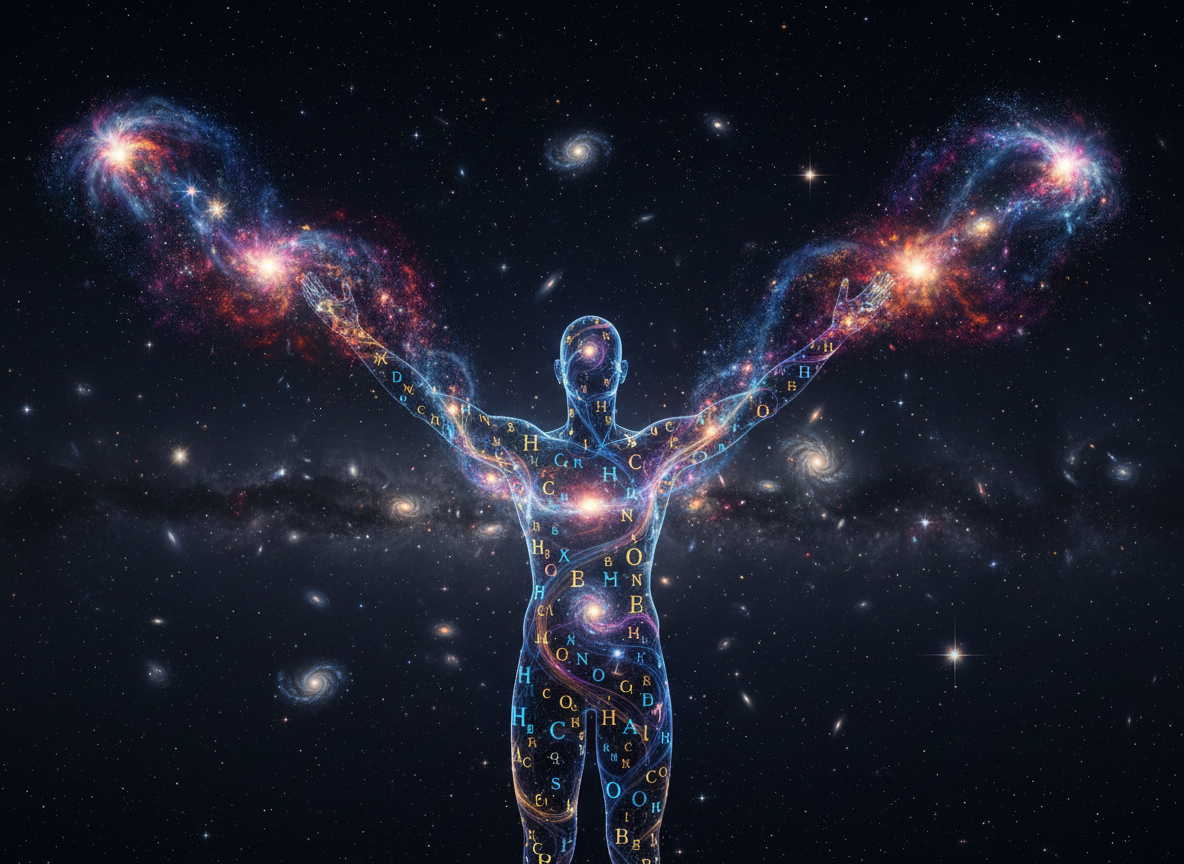
“We are made of star stuff” sounds poetic, but the underlying statement is literal. The atoms in a human body were assembled by several different cosmic processes over billions of years. Some are almost as old as the universe itself. Others were forged inside stars that died before the Sun existed.
The important correction is that there was no single cosmic factory. Hydrogen, carbon, oxygen, iron and the heaviest elements do not all share the same origin.
Your hydrogen came from the early universe
Hydrogen is the most abundant element in the universe and a major component of the water and organic molecules in your body. Almost all of that hydrogen traces back to Big Bang nucleosynthesis, when the young universe was only minutes old.
As the universe expanded and cooled, protons and neutrons formed the nuclei of hydrogen, helium and small amounts of lithium. There were no stars yet. The hydrogen atoms that later became part of oceans, cells and blood therefore began with the universe’s earliest matter.
Stars turned light elements into carbon and oxygen
Gravity later pulled primordial gas into the first stars. Inside stellar cores, high temperatures and pressures allowed nuclear fusion to combine lighter nuclei into heavier ones.
Helium fusion can produce carbon, and later stages of stellar evolution produce oxygen and other elements. Carbon is the structural foundation of organic chemistry, while oxygen is central to water and aerobic metabolism. These atoms existed in earlier generations of stars before they became ingredients in the cloud that formed the Solar System.
Iron required the lives and deaths of massive stars
Fusion in massive stars builds progressively heavier nuclei through successive burning stages. Iron sits near a turning point: fusing iron does not release energy in the same way that fusing lighter nuclei does.
When a sufficiently massive star can no longer support itself through fusion, its core collapses and the star can explode as a supernova. Those events eject material enriched by the star’s lifetime of nucleosynthesis and by explosive nuclear reactions. NASA notes that much of the iron in our bodies was produced in ancient supernova-related stellar processes.
The iron in hemoglobin, which helps transport oxygen through your blood, therefore carries a history older than Earth.
The heaviest elements have more than one origin
A common simplification says that every element heavier than iron came from supernovae. Modern astrophysics paints a more complicated picture.
Many of the heaviest nuclei are produced by neutron-capture processes. Some can form in particular stellar environments and supernovae, while neutron-star mergers are now known to be major sites of rapid neutron capture. NASA’s 2026 “Where Your Elements Came From” summary notes that gold is likely produced in large quantities during neutron-star collisions.
The origin of some elements is still an active research problem. Even a periodic table colored by source must contain uncertainty because multiple astrophysical processes can contribute to the same element.
How did those atoms reach Earth?
Stars do not keep all of the material they manufacture. Stellar winds, planetary nebulae, supernova explosions and compact-object mergers return enriched matter to interstellar space.
That recycled material mixes into clouds of gas and dust. Roughly 4.6 billion years ago, one such enriched cloud collapsed to form the Sun, planets, asteroids and the material that eventually became Earth.
Your atoms did not travel together as a package. They came from an interstellar mixture built by many earlier events across different times and places.
A human body is a cosmic mixture
By mass, the human body is dominated by oxygen, carbon, hydrogen and nitrogen, with smaller but essential amounts of calcium, phosphorus, sulfur, sodium, potassium, chlorine, magnesium, iron and many trace elements.
Those elements arrived through different nucleosynthetic histories. The body is therefore not simply “made in stars.” It is a mixture of primordial matter, stellar fusion products, explosive nucleosynthesis and material forged in some of the most violent events in the universe.
The simplest cosmic family tree
- Hydrogen: overwhelmingly from Big Bang nucleosynthesis.
- Carbon and oxygen: built largely by nuclear fusion inside stars.
- Iron: strongly associated with stellar evolution and supernova enrichment.
- Many very heavy elements: produced through neutron-capture processes, including major contributions from neutron-star mergers.
- Some isotopes: can also be created by processes such as cosmic-ray spallation.
Why “star stuff” is still a good phrase
The phrase survives because it captures something profound without being merely metaphorical. Earth formed from material enriched by earlier generations of stars. Nearly every carbon atom in a cell and every oxygen atom in a breath has passed through a cosmic history that began long before our planet.
But the more accurate version is even more interesting: we are made of Big Bang matter, star stuff and the debris of stellar catastrophes.
Watch the Muslance documentary
Frequently asked questions
Was every element in the human body made inside a star?
No. Most hydrogen was formed during Big Bang nucleosynthesis before stars existed. Many heavier elements were produced later by stellar fusion, explosions and neutron-capture events.
Where did the carbon in our bodies come from?
Carbon is produced through nuclear fusion inside stars, particularly through helium-burning reactions. That material is later released into space and recycled into new stars and planets.
Did gold come from supernovae?
Some heavy-element production can occur in explosive stellar environments, but observations and models show neutron-star mergers are major sites for rapid neutron-capture production of elements such as gold.
Read more
- ALICE Found a Strange Suppression Pattern Inside Lead Nuclei
- The Inductive Effect May Not Work Like Textbooks Say
- More Matter & Chemistry from Muslance
Leave a Reply