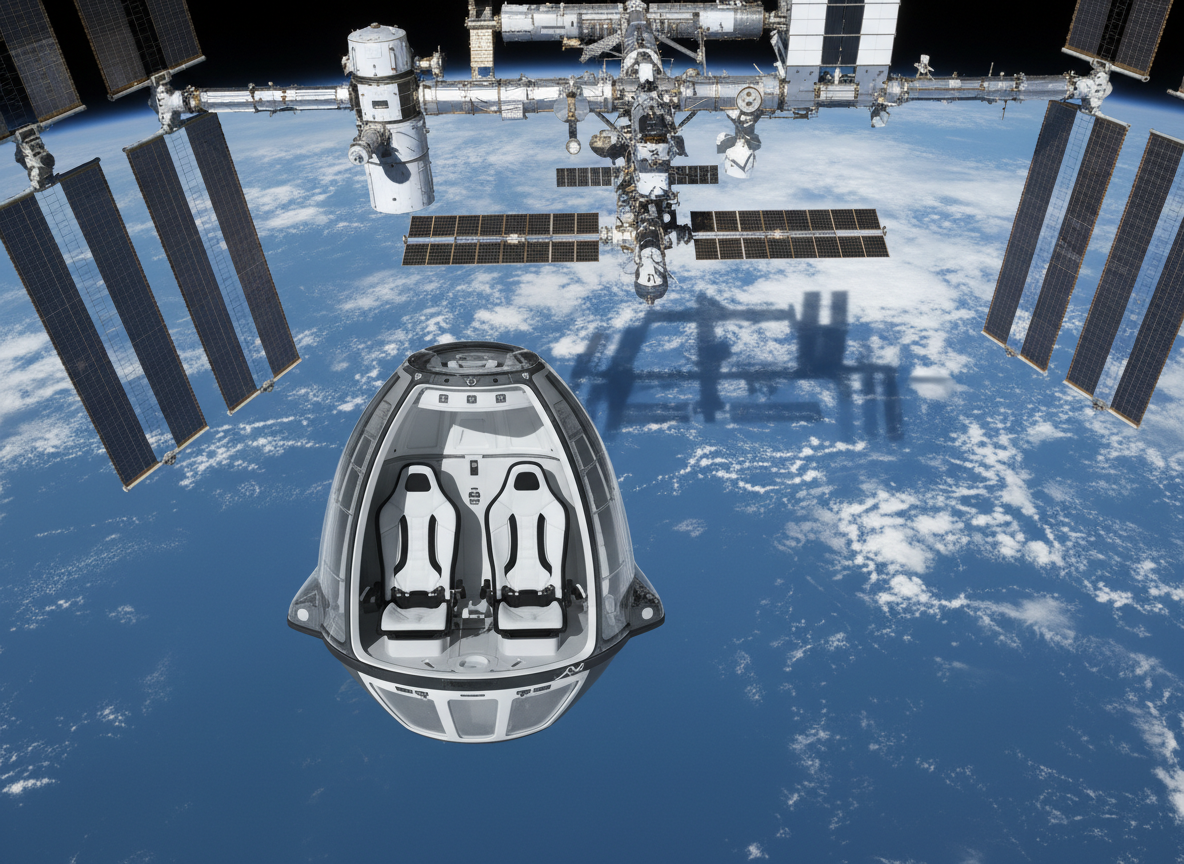
When SpaceX launched NASA’s Crew-9 mission on September 28, 2024, the Dragon capsule lifted off with something unusual: two empty seats.
Those seats were not a mistake and they were not wasted capacity. NASA had deliberately left them open for astronauts Butch Wilmore and Suni Williams, whose planned short stay aboard the International Space Station had turned into a months-long mission after Boeing’s Starliner developed propulsion and helium-leak concerns.
How a Short Starliner Test Flight Changed
Wilmore and Williams launched aboard Boeing’s Starliner in June 2024 on the spacecraft’s first crewed flight test. The mission was intended to be relatively brief, but engineers encountered helium leaks and reaction-control thruster problems during the flight.
NASA spent weeks reviewing data and running tests. The key question was not whether Starliner could physically attempt a return with its crew, but whether the remaining uncertainty created more risk than NASA was willing to accept for a crewed reentry.
NASA Chose the Lower-Risk Return Plan
On August 24, 2024, NASA announced that Starliner would return to Earth without Wilmore and Williams. The agency said the decision followed an extensive safety review and reflected the uncertainty surrounding the spacecraft’s propulsion system.
That decision immediately created a logistical problem: two astronauts were still aboard the station, and NASA needed a safe way to bring them home.
Why Crew-9 Launched With Only Two People
Crew-9 had originally been planned as a four-person mission. NASA reconfigured it so that only astronaut Nick Hague and Roscosmos cosmonaut Aleksandr Gorbunov would launch aboard Dragon.
The other two seats were intentionally kept free for Wilmore and Williams. In practical terms, NASA turned a normal crew-rotation mission into part of a contingency plan.
Crew-9 launched from Cape Canaveral on September 28, 2024 and docked with the International Space Station the following day. From that point onward, the empty seats had a clear purpose: they were reserved for the astronauts Starliner would no longer carry home.
The Long Way Home
Wilmore and Williams remained aboard the station as part of the Expedition crew while waiting for Crew-9’s return. Their mission, initially expected to last only days, stretched to 286 days in space.
On March 18, 2025, Dragon returned Hague, Gorbunov, Wilmore and Williams to Earth. The capsule splashed down safely off the coast of Florida.
What the Empty Seats Really Represented
The two empty seats became a visible symbol of redundancy in human spaceflight. NASA had multiple spacecraft, multiple commercial partners and enough mission flexibility to redesign a crew rotation after a major technical uncertainty emerged.
That redundancy mattered because human spaceflight is not only about whether a vehicle can complete a mission. It is also about how much uncertainty an agency is willing to accept when lives are involved.
Crew-9’s unusual configuration showed how backup capability can become part of the mission itself. The empty seats were not unused space. They were the solution to a problem that had not existed when the flight was first planned.
Watch the Muslance Documentary
The Muslance documentary explains how the Starliner safety decision reshaped Crew-9 and why two intentionally empty seats became one of the most striking examples of contingency planning in recent human spaceflight.
Sources
- NASA — Decision to return Starliner without crew
- NASA — Crew-9 changes ahead of launch
- NASA — Crew-9 launch
- NASA — Crew-9 mission overview and return
Leave a Reply