MUSLANCE / PALEONTOLOGY & EVOLUTION
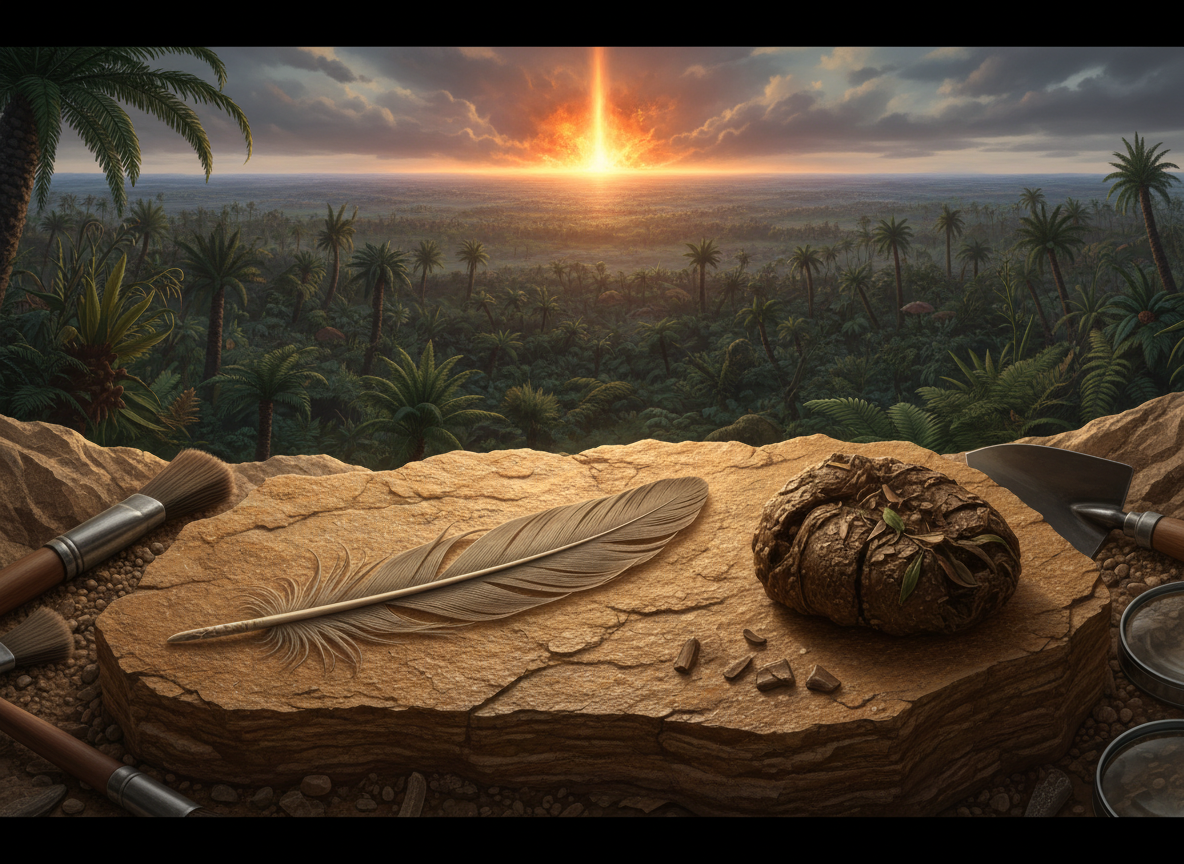
A small piece of fossilized dung from Montana preserved an extraordinary food-chain snapshot: feathers and bones from an extinct bird, plus tiny fish scales that were probably part of the bird’s last meal before the bird itself was eaten by a large theropod.
The fossil is about 66 million years old. More importantly, the feather’s structure may add a new piece to one of paleontology’s biggest questions: why did the ancestors of modern birds survive the end-Cretaceous mass extinction while every other known bird lineage disappeared?
The fossil was found inside a coprolite
In 2016, researcher David DeMar Jr. found a dark reddish-brown nodule in the Hell Creek Formation of eastern Montana. A tiny feather was visible where the fossil had broken open.
The object turned out to be a coprolite—fossilized feces—from a large meat-eating dinosaur. Researchers cannot identify the predator with certainty, but its size and the local fauna make a tyrannosaur such as a young Tyrannosaurus rex or Nanotyrannus a plausible producer.
CT scans revealed an entire miniature ecosystem
Micro-CT imaging showed that the coprolite contained more than the exposed feather. Inside were additional feathers, pieces of bird bone and tiny gar-fish scales.
The fish scales were probably too small to have been targeted directly by the large theropod. The researchers instead interpret them as stomach contents of the bird. In that reconstruction, a fish was eaten by the aquatic bird, and the bird was then eaten by the dinosaur.
The bird was not a member of the modern bird lineage
Skeletal remains in the coprolite point toward a hesperornithiform, an extinct group of flightless aquatic birds. Hesperornithiforms were relatively close to modern birds in the avian family tree, but they were outside Neornithes—the lineage that includes every living bird today.
That distinction is crucial. If a sophisticated feather type existed in a non-neornithine bird shortly before the asteroid impact, then some feather features once thought potentially unique to the surviving lineage were already present outside it.
The feather looked surprisingly modern
The researchers measured the architecture of the preserved feather and found a low structural index and high barb density, features associated with reduced penetrability and effective insulation in modern aquatic birds.
In simpler terms, the plumage was not obviously primitive. The feather belonged to an extinct lineage, yet it possessed a structure that would look functionally familiar in living birds.
Why feathers matter to an asteroid extinction
The Chicxulub impact 66 million years ago triggered global environmental disruption. Dust, soot and aerosols blocked sunlight, food webs collapsed and global temperatures likely fell during an “impact winter.”
Thermal insulation could therefore have mattered enormously. Small animals trying to survive prolonged darkness and cold would need to retain heat while coping with drastically reduced food supplies.
The new fossil does not prove that feathers determined survival. Instead, it changes the comparison. An extinct bird lineage already had modern-like insulating feather architecture, so survival cannot be explained simply by saying modern birds alone had “better feathers.” Researchers must look at more subtle differences in plumage, ecology, growth and behavior.
The study may narrow the survival mystery rather than solve it
Only one avian branch, Neornithes, survived the end-Cretaceous extinction and later diversified into the roughly 11,000 living bird species. Many hypotheses have been proposed for that survival: small body size, beak shape, ground-dwelling habits, seed eating, flexible development and plumage.
The coprolite feather shows that some “modern” plumage characteristics had spread beyond the surviving lineage. That forces researchers to ask which exact feather traits—or combinations of traits—might still have differed.
Coprolites may preserve soft tissues we have overlooked
The discovery also introduces a new source of paleontological information. Feathers are delicate and rarely survive in Late Cretaceous terrestrial deposits such as Hell Creek. Coprolites can shield tiny biological remains during burial and mineralization.
The authors argue that other fossil droppings in museums and field collections may contain feathers or other soft tissues that have never been recognized because nobody thought to scan them for such material.
What this fossil actually tells us
- Modern-like feather structure existed outside modern birds. The hesperornithiform feather had dense, low-penetrability architecture.
- The fossil preserves a food chain. Fish remains were likely inside the bird before the bird was consumed by a theropod.
- Feathers alone do not yet explain survival. The extinction difference was probably multi-factorial.
- Coprolites are an underused soft-tissue archive. CT scanning could reveal more hidden feathers and prey remains.
Watch the Muslance documentary
Frequently asked questions
Was the feather from a modern bird?
No. The associated bones indicate an extinct hesperornithiform bird outside Neornithes, the group that includes all living birds.
Did the feather prove why birds survived the asteroid?
No. It provides a new clue and constrains hypotheses about plumage and insulation. The survival of Neornithes likely involved multiple ecological and biological factors.
Which dinosaur produced the coprolite?
The producer cannot be identified with certainty. Researchers consider a tyrannosaur such as a young T. rex or Nanotyrannus plausible based on the coprolite and local fauna.
Read more
- T. rex Ran at About 97°F — Its Teeth Kept the Evidence
- The First Likely Adult T. rex Trackway Shows How It Walked
- More Paleontology & Evolution from Muslance
Leave a Reply