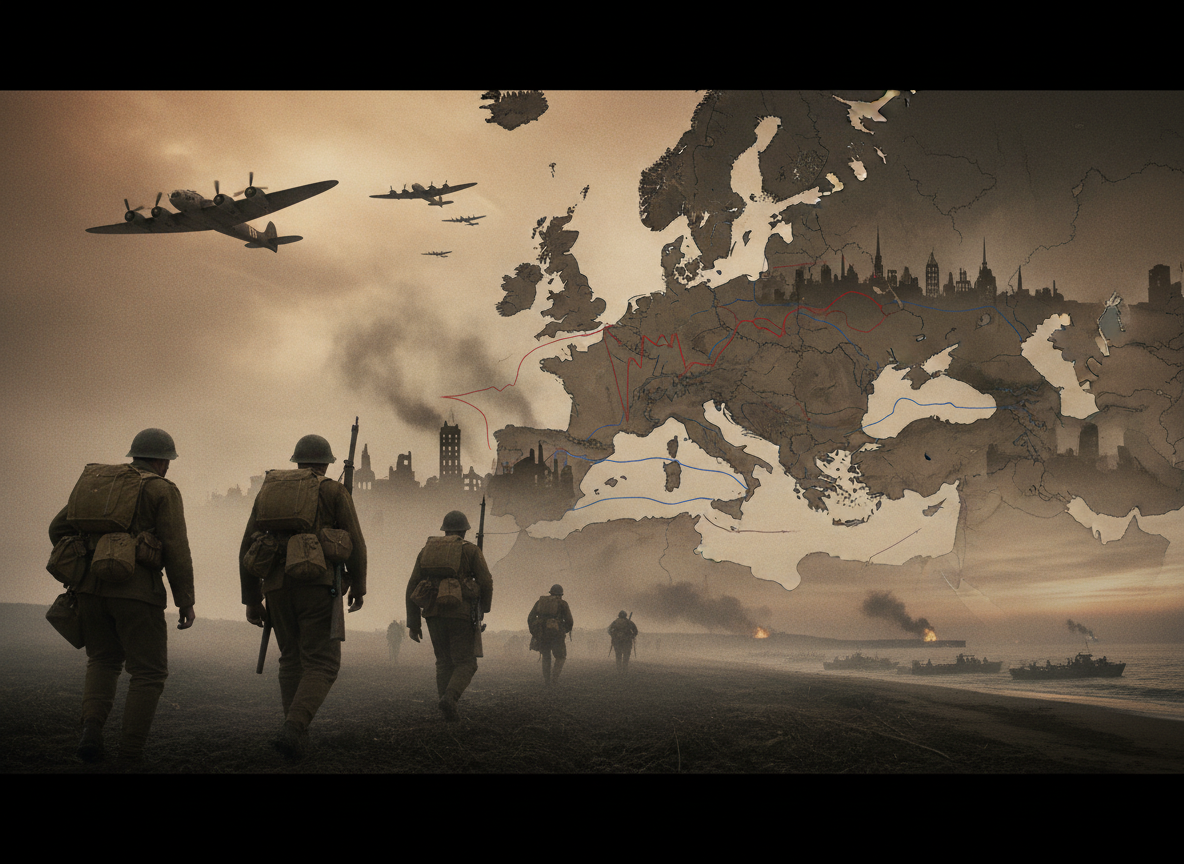
World War II was a global conflict that transformed politics, economies, borders and societies on an enormous scale. Beginning in Europe in 1939 and ending in 1945, the war spread across Europe, North Africa, Asia and the Pacific.
How World War II began
The war had multiple causes. The post–World War I settlement, political instability, economic crisis, aggressive expansion by authoritarian states and the rise of Nazi Germany all shaped the path toward conflict. Germany’s invasion of Poland on September 1, 1939 triggered declarations of war by Britain and France.
From European war to global conflict
Germany achieved rapid victories across much of Europe, but the conflict widened dramatically in 1941 with the German invasion of the Soviet Union and Japan’s attack on Pearl Harbor. The United States entered the war, while fighting intensified from the Atlantic to the Pacific.
The turning points
Stalingrad, Midway, El Alamein and other battles altered the strategic balance. In June 1944, Allied forces landed in Normandy on D-Day and began the liberation of Western Europe. Soviet armies advanced from the east, while the Pacific war moved steadily toward Japan.
The end and aftermath
Nazi Germany surrendered in May 1945. Japan formally surrendered in September after the atomic bombings of Hiroshima and Nagasaki and the Soviet declaration of war against Japan. The conflict left tens of millions dead and helped produce a new international order dominated by the United States and Soviet Union.
Read more from Muslance
- St. John Philby: The British Explorer Who Became Ibn Saud’s Adviser
- Henry Kissinger: 10 Facts About His Life, Power and Controversial Legacy
Watch more documentaries on Muslance on YouTube.
Leave a Reply